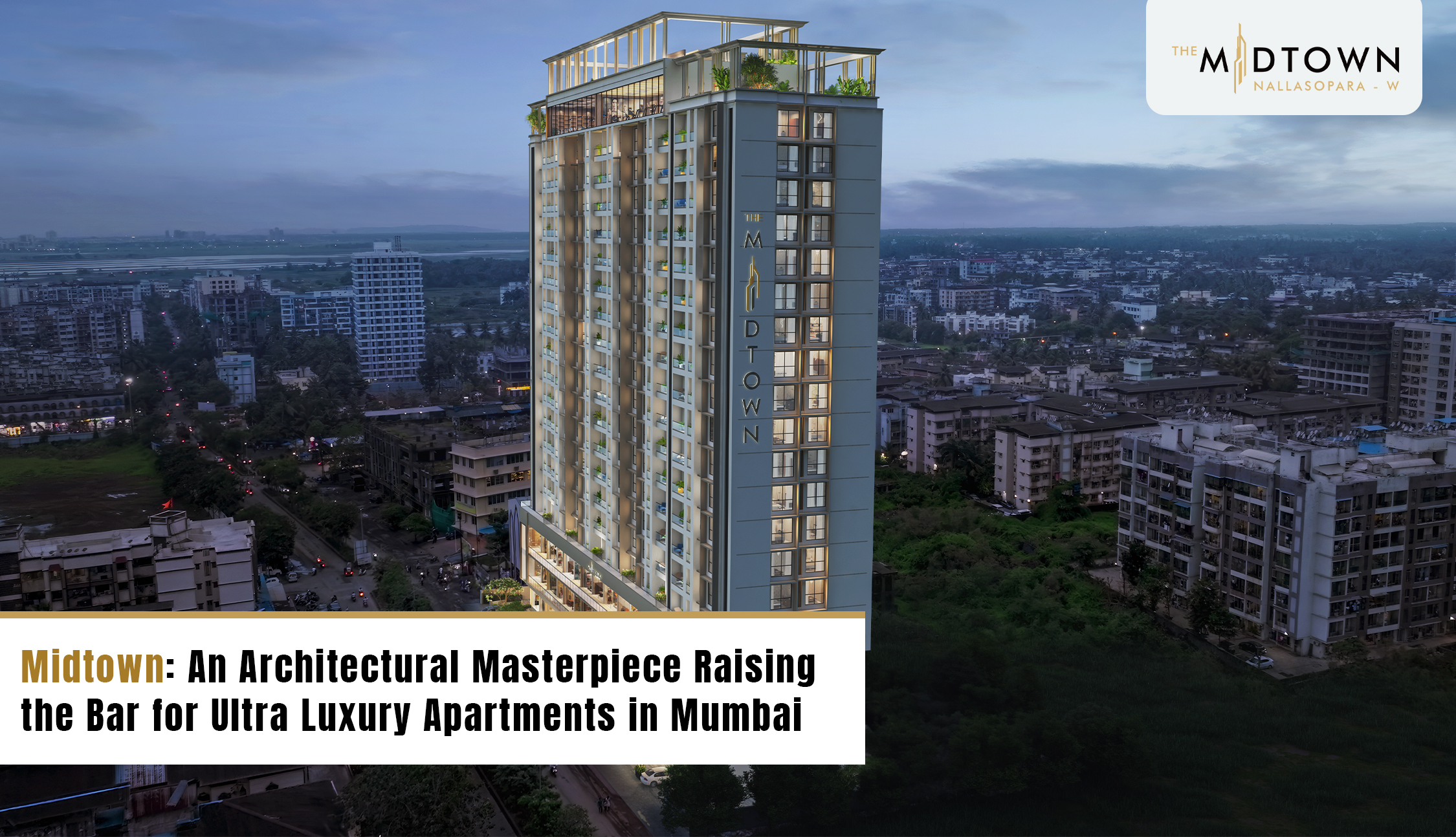
Midtown: An Architectural Masterpiece Raising the Bar for Ultra Luxury Apartments in Mumbai
Mumbai’s luxury housing landscape is undergoing a meaningful transformation. Today’s premium homebuyer is no longer satisfied with height, glass façades, or branded fittings alone. The expectation has evolved toward integrated lifestyle design, intelligent layouts, strong community planning and long-term livability.
In this changing market, Midtown has emerged as a landmark residential development that brings architectural clarity and lifestyle depth together, positioning itself among the most talked-about ultra luxury apartments in Mumbai’s expanding metropolitan region.
Rather than treating luxury as a decorative layer, Midtown approaches it as a structural principle, visible in its master planning, spatial design, amenity ecosystem and residential experience.
This is what truly differentiates next-generation luxury living.
Luxury Living Is Now Defined by Design Intelligence and Not Just Decor
For years, premium housing marketing focused heavily on finishes, marble, modular kitchens, imported fixtures. But seasoned buyers now evaluate homes differently. They look at airflow, daylight movement, privacy lines, usable space ratios and circulation planning.
Midtown’s architectural approach reflects this evolved mindset.
Residences are designed with proportional balance and functional flow. Living areas connect naturally to balconies and views. Bedrooms are placed for privacy. Kitchen zones are practical rather than ornamental. Storage is integrated into layout logic rather than added later as a compromise.
This design discipline is one of the key reasons buyers comparing ultra luxury flats in Mumbai increasingly prioritize projects like The Midtown that demonstrate architectural thinking rather than surface-level luxury.
Luxury today is not excess but it is precision.
Amenities That Support Everyday Life, Not Just Brochure Appeal
Many so-called super luxury apartments in Mumbai advertise long amenity lists, but practical usability is often limited. Midtown’s amenity philosophy is built around frequency of use, not marketing volume.
Instead of rare-use luxury features, the project emphasizes daily-life amenities such as:
● Fitness and wellness facilities
● Walking and jogging spaces
● Children’s play environments
● Social gathering areas
● Indoor recreation zones
● Community celebration spaces
● Senior-friendly seating zones
These are the features that actually shape lifestyle satisfaction over time.
When evaluating ultra luxury homes Mumbai buyers increasingly ask one question:
“Will I actually use these amenities weekly?”
Midtown’s planning answers that question with clarity.
Configuration Diversity for Different Life Stages
A strong sign of a mature luxury development is configuration diversity. Instead of forcing a single format across all buyers, Midtown offers multiple residential configurations aligned with different needs.
Available formats include well-planned 2 BHK, 3 BHK and 4 BHK residences, each designed with proportional room sizing and practical layout flow.
Young professionals, nuclear families, growing households and multi-generation families can all find suitable options within the same project ecosystem. That strengthens community stability and long-term occupancy quality.
This is one reason Midtown is often discussed alongside the best ultra luxury apartments in Mumbai emerging across growth corridors, it is built for demographic flexibility, not narrow buyer profiling.
Architecture That Creates Identity, Not Just Height
In luxury real estate, architecture is not only about appearance, it is about recognizability. Memorable projects create skyline identity.
Midtown’s design language focuses on structured geometry, façade rhythm and proportional balance rather than visual clutter. The towers are designed to feel contemporary yet timeless, avoiding short-term stylistic trends that age poorly.
Strong architectural identity contributes to:
● Project recall value
● Brand strength
● Buyer confidence
● Long-term visual relevance
This matters particularly when marketing luxury apartments in Mumbai for sale, where buyer comparison is intense and visual differentiation influences decision-making.
Location Advantage Within a Growing Urban Belt
While legacy South Mumbai addresses remain premium, infrastructure expansion is shifting attention toward well-connected growth belts across the Mumbai Metropolitan Region.
Midtown benefits from its placement within a rapidly developing corridor supported by improving transport links, road connectivity and civic infrastructure. For buyers evaluating ultra luxury apartments in Mumbai for sale, connectivity trajectory is often more important than current distance.
Projects located within infrastructure growth arcs historically show:
● Better appreciation cycles
● Stronger resale demand
● Higher rental stability
● Faster neighborhood development
This makes Midtown attractive not only to end users but also to strategic investors.
Community-Centric Planning Is the New Luxury Signal
Earlier definitions of luxury emphasized exclusivity. Modern luxury emphasizes community quality.
Premium buyers now value well-managed communities, shared celebration spaces and social infrastructure. Midtown incorporates this thinking through its event-friendly common areas and community planning approach.
Spaces designed for festivals, gatherings and resident engagement help create emotional attachment to place, a major driver of long-term residential satisfaction.
Among emerging ultra luxury properties in Mumbai, community-centric design is becoming a major differentiator and Midtown aligns well with this direction.
Why Midtown Represents Next-Generation Luxury Housing
When evaluated through an expert real estate lens, Midtown checks several critical boxes:
● Architectural intent
● Master planning depth
● Amenity usability
● Configuration diversity
● Lifestyle ecosystem
● Growth corridor positioning
● Community infrastructure
That combination is what separates marketing luxury from structural luxury.
And structural luxury is what sustains value.
FAQs
What makes Midtown different from other ultra luxury apartments in Mumbai?
Midtown focuses on master planning, usable amenities, architectural identity, and lifestyle ecosystem rather than only interior finishes.
Are Midtown homes suitable for families looking for ultra luxury flats in Mumbai?
Yes. The layouts, open spaces, and amenity planning are strongly family-oriented and support long-term living.
What configurations are available at Midtown?
Buyers can choose from premium 2, 3 and 4 BHK residences designed with functional layout logic.
Are buyers actively searching for luxury apartments in Mumbai for sale outside core city zones?
Yes. Infrastructure-led growth corridors are increasingly attracting premium buyers and investors.
Is Midtown a good option among luxury apartments in Mumbai for sale?
Yes. Its architectural identity, connectivity growth potential, and practical lifestyle features strengthen its positioning.