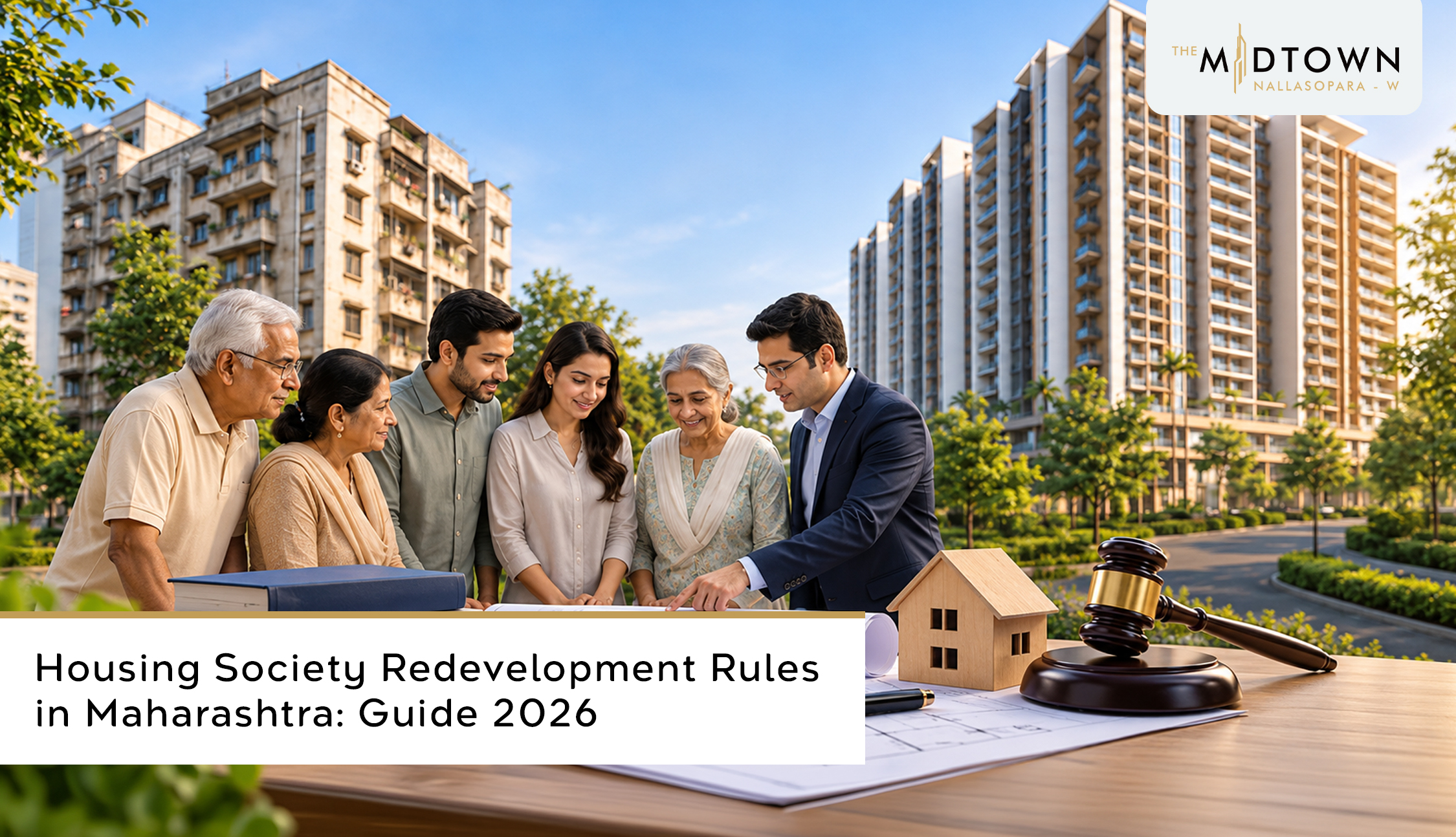
Housing Society Redevelopment Rules in Maharashtra: Guide 2026
Understanding the Housing Society Redevelopment Rules in Maharashtra is essential for homeowners planning to redevelop ageing residential buildings. Redevelopment can improve structural safety, provide modern amenities and enhance living conditions. However, the process requires legal compliance, member approval, financial planning and careful developer selection. In September 2026, the Maharashtra government introduced revised redevelopment guidelines focusing on transparency, member protection and project accountability. This guide explains the latest rules, redevelopment procedures, required documents and important considerations for housing societies.
What Is Housing Society Redevelopment?
Housing society redevelopment is the process of replacing an old residential building with a new structure on the same property, subject to applicable approvals.
The objective is to provide safer homes, improved infrastructure, efficient layouts and modern residential facilities.
Redevelopment may offer residents additional carpet area, parking, upgraded amenities and better building safety systems, depending on project feasibility and negotiated agreements.
In cities such as Mumbai, Thane and Pune, redevelopment is particularly relevant for societies dealing with ageing buildings and increasing maintenance requirements.
What Are the Housing Society Redevelopment Rules in Maharashtra in 2026?
The Maharashtra government's revised order dated September 30, 2026, establishes updated procedures for cooperative housing society redevelopment.
Issued under Section 79A of the Maharashtra Co-operative Societies Act, 1960, the order replaces the July 4, 2019 redevelopment guidelines.
Important provisions include:
-
51% Member Approval: At least 51% of the society's total membership must approve the redevelopment decision.
-
Two-Thirds Quorum: Specified redevelopment meetings require participation from at least two-thirds of total members.
-
Professional Evaluation: The society must appoint an eligible architect or Project Management Consultant (PMC).
-
Transparent Tendering: Societies must seek competitive proposals from developers, generally obtaining at least three bids.
-
Meeting Documentation: Important proceedings must be properly recorded, with video recording required for specified meetings.
-
Project Completion: The revised framework provides for completion within two years from the plinth certificate, with exceptional cases extending to three years.
These requirements aim to improve accountability and protect the interests of housing society members.
Housing Society Redevelopment Process: Step-by-Step Guide
The housing society redevelopment process involves several stages that help ensure transparency and legal compliance.
Step 1: Initiating the Redevelopment Proposal
At least one-fifth of society members can submit a written request to initiate the redevelopment discussion.
The managing committee must record the request and arrange a Special General Body Meeting according to the prescribed procedure.
Step 2: Conducting a General Body Meeting
Members discuss the proposed redevelopment and vote on whether the society should proceed.
A two-thirds quorum is necessary, and at least 51% of total members must approve the decision.
For example, a society with 100 members requires a quorum of 67 and at least 51 affirmative votes.
Step 3: Appointing an Architect or PMC
The society appoints a qualified architect or PMC to evaluate the building's redevelopment potential.
The professional examines building conditions, land records, permissible development area, project feasibility and financial considerations.
Step 4: Inviting Developer Tenders
The society invites competitive developer proposals through the prescribed tendering process.
Proposals should be evaluated based on experience, financial stability, construction quality, proposed carpet area, transit rent and completion commitments.
Step 5: Selecting the Developer
Members review shortlisted developers and vote according to the applicable procedures.
The selection process must be transparent and properly documented.
Step 6: Signing Legal Agreements
After developer selection, the society executes the necessary agreements.
These should clearly specify accommodation benefits, construction timelines, financial responsibilities and safeguards against delays.
Step 7: Obtaining Approvals and Starting Construction
The developer obtains applicable planning permissions before construction begins.
Residents should vacate only after the required approvals, contractual protections and agreed transit arrangements are in place.
Important Redevelopment of Housing Society Rules Every Member Should Know
Understanding the redevelopment of housing society rules helps residents make informed decisions and avoid contractual disputes.
Member Consent and Participation
Society members must receive adequate information about redevelopment proposals before voting.
The revised framework also provides for remote participation by eligible members under specified conditions, while retaining physical attendance requirements.
Temporary Accommodation and Transit Rent
Residents may need temporary accommodation during construction.
The development agreement should clearly mention transit rent, payment schedules, security deposits where applicable and arrangements for delayed possession.
Developer Financial Capacity
A developer's financial condition is an important factor.
Societies should evaluate completed projects, available funding, legal history, construction capabilities and the financial safeguards offered.
Carpet Area and Parking Rights
Every member should verify the proposed carpet area, flat allocation, parking provisions and specifications before signing individual agreements.
Promises made during negotiations should be included in legally enforceable documents.
Housing Society Rules and Regulations in Maharashtra: Required Documents
Following housing society rules and regulations in Maharashtra requires accurate records and legal documentation.
Important documents generally include:
-
Society registration certificate and registered bye-laws.
-
Property card, conveyance deed and ownership documents.
-
Existing building plans and approved layouts.
-
Structural assessment and redevelopment feasibility report.
-
General body meeting notices and resolutions.
-
Member consent letters and voting records.
-
Developer tender documents and comparative statements.
-
Development agreement and Permanent Alternative Accommodation Agreements (PAAA).
-
Applicable statutory permissions and project approvals.
Additional documentation may be necessary depending on the land category, planning authority and redevelopment scheme.
An independent legal review is recommended before executing binding agreements.
Benefits of Housing Society Redevelopment
Redevelopment can offer long-term advantages when properly planned and executed.
Improved Safety: Modern structural design and updated building systems can improve residential safety.
Better Living Spaces: Efficient layouts and potentially increased carpet area can enhance everyday comfort.
Modern Amenities: New developments may provide elevators, parking facilities, security systems and recreational spaces.
Reduced Maintenance Issues: Replacing deteriorating infrastructure can reduce recurring repair problems.
Potential Property Value Improvement: Modern homes with updated amenities may attract stronger market interest, although appreciation is not guaranteed.
The benefits ultimately depend on location, project feasibility, construction quality and developer performance.
Common Mistakes to Avoid During Redevelopment
Housing societies should avoid selecting developers solely on the basis of additional carpet area or attractive financial promises.
Other common mistakes include:
-
Ignoring the developer's financial stability.
-
Proceeding without proper title verification.
-
Signing agreements with unclear possession timelines.
-
Failing to document transit-rent commitments.
-
Overlooking construction specifications and member entitlements.
Careful planning, transparent communication and professional guidance can reduce redevelopment risks.
The Midtown: Building Better Residential Environments
The Midtown recognises the importance of quality construction, practical planning and comfortable residential environments.
For housing society members considering redevelopment, choosing qualified development professionals and carefully evaluating project commitments are important steps towards long-term residential security.
Understanding redevelopment regulations helps homeowners assess construction quality, transparency and the overall value of their housing investment.
Conclusion
Understanding the Housing Society Redevelopment Rules in Maharashtra is essential for homeowners planning to transform ageing residential buildings into modern communities.
The September 2026 guidelines emphasise member participation, transparent developer selection, legal documentation and defined construction timelines.
By following the prescribed procedures and obtaining professional guidance, housing societies can reduce redevelopment risks and work towards safer, better-designed homes.
Frequently Asked Questions (FAQs)
1. What is the minimum consent required for housing society redevelopment in Maharashtra?
Under the September 2026 framework, at least 51% of the society's total membership must approve the redevelopment decision, subject to the prescribed meeting procedures.
2. Is a PMC compulsory for housing society redevelopment?
The revised guidelines require the selection of an eligible architect or Project Management Consultant to prepare the redevelopment project report and support the technical assessment.
3. How long does housing society redevelopment take in Maharashtra?
The 2026 framework provides for project completion within two years from the plinth certificate, extendable to three years in exceptional circumstances. Planning, approvals and other preliminary stages can require additional time.
4. Can a housing society undertake self-redevelopment?
Yes. Eligible cooperative housing societies can explore self-redevelopment, subject to applicable government directions, financial feasibility and statutory permissions.
5. Can members receive additional carpet area after redevelopment?
Yes, additional carpet area may be available depending on development potential, applicable building regulations and the terms agreed between the society and developer.